Got it. Writing the intro and first 5 H2 sections now, sticking to the approved TOC and all style rules.
If your barn sits beyond your home's Wi-Fi range, you've probably searched for a security camera for barn without internet and found mostly dead ends. Most cameras today assume you have reliable Wi-Fi, cloud accounts, and a strong signal. That's not your world.
Your barn is dusty, cold in winter, and maybe a half-mile from your router. The good news? You don't need internet at all.
Cellular-based cameras, solar-powered trail cams, and local-recording setups all work in remote locations. As of 2026, even budget models offer 1080p video, infrared night vision, and weeks of battery life. The right system depends on your power, coverage, and how you want to watch.
Let's walk through it.
Quick Answer
Yes, you can monitor a barn with no internet. Use a 4G/LTE cellular camera, a trail camera with microSD storage, or a solar-powered standalone unit. These cameras record locally or transmit over cellular networks.
Choose one that matches your power source and signal strength.
Why Your Barn Camera Setup Is Different From a Home Camera
A home camera sits in a controlled environment. Your barn doesn't. Temperature swings, dust, hay particles, and metal siding all affect performance.
Metal buildings in particular block Wi-Fi and cellular signals, so placement matters more than you'd think.
Power is another issue. Most barns lack convenient outlets near mounting points. That means battery life and solar charging become critical features, not optional extras.
You're also dealing with larger spaces. A typical living room camera covers 30 feet. A barn aisle or hay loft needs a wider field of view and longer night vision range.
If you're already planning a broader surveillance setup, it's worth understanding how barn cameras fit into your overall approach. Our guide on picking the right home security system covers the basics that still apply, even in an outbuilding.
Finally, think about who and what you're monitoring. Livestock, equipment, vehicles, or just curious trespassers? Each scenario changes your camera choice.
If you're protecting machinery and tools in a detached shed, you'll need different specs than someone watching a foaling stall.
The 3 Ways to Power a No-Internet Barn Camera
Before choosing a camera, decide how it will get power. This one decision narrows your options more than any other factor.
Battery-Powered Cameras
Battery cameras are the easiest to install. No wiring. No electrician.
Just mount and go. Most use rechargeable lithium-ion packs rated for 1 to 6 months of use, depending on motion activity.
The tradeoff? Cold weather drains batteries fast. A battery that lasts 3 months in summer might die in 3 weeks at freezing temperatures.
If you live in a northern climate, budget for winter recharging or pick a model with a solar panel.
Solar-Powered Cameras
Solar cameras pair a small panel with an internal battery. The panel keeps the battery topped off during daylight hours. In full sun, many models run indefinitely without manual charging.
This works brilliantly for south-facing barn walls or fence posts. Shaded locations are another story. A camera mounted inside a barn or under a roof overhang won't get enough sunlight.
In that case, you're back to a battery-only unit or a low-voltage AC option.
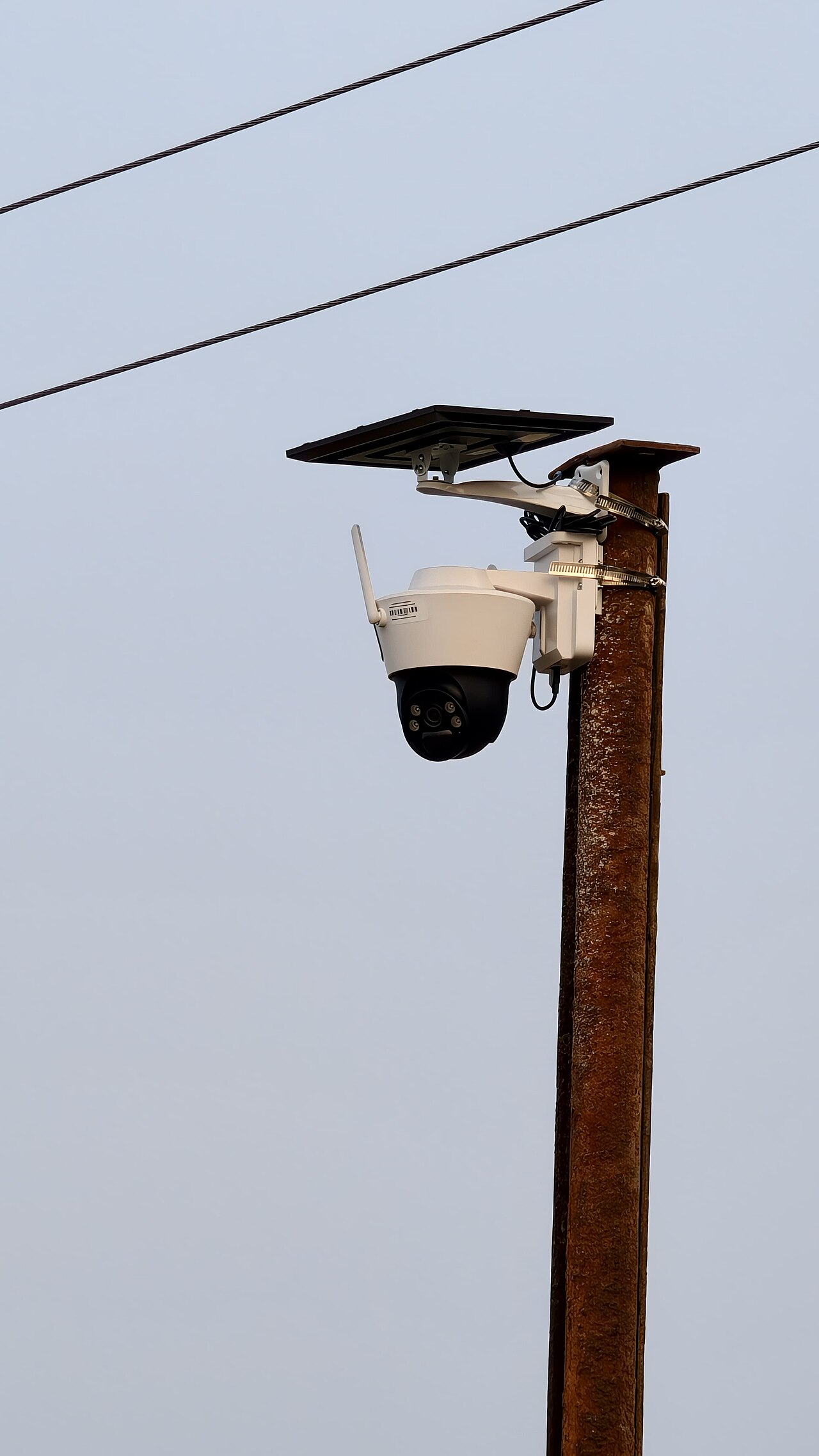
Image source: Wikimedia Commons / Eyetechsecurities (CC BY)
AC-Powered Cameras
If your barn has an outlet within reach, AC-powered cameras are the most reliable option. No battery anxiety. No solar dependence.
They just work, 24/7.
The downside is installation. You'll need a weatherproof power adapter, proper cable routing, and ideally a GFCI outlet. Extension cords across a barn floor are a trip hazard and a fire risk.
If you're handy, this is a solid option. If not, stick with battery or solar.
Here's a quick comparison:
| Power Source | Best For | Catch |
|---|---|---|
| Battery | Quick setup, remote posts | Cold weather shortens life |
| Solar | South-facing, full-sun spots | Useless in shade |
| AC | Barns with existing outlets | Needs careful wiring |
Cellular vs. Local-Only: How Do You Want to Watch?
Your second big decision is how you'll view footage. Do you need to check the barn from your phone while you're in town? Or is it enough to pull an SD card and review what happened overnight?
Cellular Cameras (4G/LTE)
These cameras have a SIM card slot, just like a phone. They connect to cellular networks and send footage to your app in real time. You can watch live video, get motion alerts, and review clips anywhere.
You'll pay for data, but plans are cheap. Expect $5 to $15 per month for a basic plan with a few hundred megabytes. That's enough for short clips and occasional live views.
Cellular is the right choice if you travel, have multiple buildings, or need to know the moment something happens. It's also essential if someone might break in while you're miles away.
Local-Only Trail Cameras
Trail cameras have no SIM slot and no live view. They record motion-triggered clips to a microSD card. To see footage, you remove the card and read it on a laptop or phone.
The appeal is simplicity. No monthly costs. No signal issues.
Just set it and forget it. Many hunters already use these for scouting, and they work identically in a barn.
The big limitation is timing. If a theft happens on Tuesday, you won't know until you check the card Wednesday afternoon. That's fine for documentation, but useless for catching someone in the act.
For coverage in remote areas where cellular is spotty, a local-only approach is often the only reliable option. But before going that route, check what your carrier actually covers at your barn's location. Our article on rural property security explains how to scope out signal limitations properly.
The Hybrid Option
Some cameras do both. They record locally to an SD card and also offer optional cellular connectivity. You pay for data only when you need it.
This gives you the best of both worlds, though the hardware costs a bit more.
What to Look For in a Barn Camera: Key Specs That Matter
Once you've settled on power and connectivity, compare specs. Not all cameras survive barn life. These are the numbers that actually matter.
Weatherproofing (IP Ratings Explained Simply)
Look for an IP65 rating at minimum. That means it's sealed against dust and low-pressure water spray. IP66 or IP67 is even better for rain exposure.
Hay dust is fine particulate, and it gets into everything. A higher rating directly reduces camera failure.
If you're looking for a camera that's built for harsh outdoor conditions, our guide to cold-weather models covers the extra sealing and heating features that extended below-freezing use demands.
Night Vision That Actually Works in a Dark Barn
Barns are pitch black at night. You need infrared (IR) LEDs with a rated range of at least 30 to 60 feet. Most cheap cameras claim 30 feet.
That's only enough for a single stall or a doorway.
Check the IR wavelength too. While that sounds technical, it directly affects image clarity. Cameras with a wider IR spread illuminate the whole alleyway instead of just a bright hotspot.
Image source: Wikimedia Commons / US Air Force from USA
Motion Detection Without 50 False Alerts a Night
Barn animals move. Cats, chickens, and shifting shadows all trigger motion sensors. When every gust of wind sets off a notification, you'll stop checking your phone.
Look for cameras with adjustable sensitivity and detection zones. Some models let you draw a specific area on the video feed, so only movement inside that zone triggers alerts. You can generally tune out the part of the barn where the animals wander and focus on entry points instead.
Storage Options: SD Card, NVR, or Cloud-Free Local
No-internet cameras typically store footage one of two ways:
- MicroSD card inside the camera, up to 512GB
- A separate NVR (network video recorder) box wired to multiple cameras
MicroSD is simple and works in most trail cams. A 256GB card holds anywhere from 1 to 3 weeks of motion-triggered clips at 1080p. NVR systems are heavier-duty but require wiring and more setup.
Cellular cameras may also offer cloud storage over LTE. That's convenient, but it adds another monthly fee. If you're trying to avoid subscriptions entirely, stick with local storage.
Choosing the Right Camera for Your Barn: A Simple Decision Guide
Start with your biggest constraint: power. No outlet and full sun? Choose solar-powered.
No outlet and mostly shade? Battery-only. An outlet nearby?
AC-powered wins every time.
Then think about how you'll watch. Need alerts on your phone? Go cellular.
Fine with reviewing footage later? Save money with a trail camera.
Scenario 1: You Need to See Livestock From Your Phone
If you're monitoring a pregnant mare or cattle during calving season, live alerts are worth the data plan. Use a 4G/LTE camera with a solar panel. You'll get notified when labor starts, even from inside the house.
Point the camera at the stall, set motion detection to high, and keep the app open.
Scenario 2: You Only Need Footage After the Fact
Checking for thieves or documenting property damage? A trail camera is plenty. Pop the microSD card out every few days and review it on your laptop.
No monthly costs, no signal issues. This is the cheapest setup that actually works.
Scenario 3: You Have a Distant Shed or Hay Storage Area
Pick a solar-powered 4G camera with a high-capacity battery. Bigger solar panels, around 10W or more, keep it charged through shorter winter days. Aim it at the entrance, not the entire field.
You'll get better motion detection and longer battery life that way.
Scenario 4: Your Barn Has Power But No Internet
An AC-powered camera with local storage is the right call here. You get continuous recording without battery anxiety. Some AC models also accept a cellular module later, so you can add remote viewing without replacing hardware.
That's a nice upgrade path.
The Best Camera Options Compared
| Camera Type | Power | Connectivity | Live View | Monthly Cost | Best For |
|---|---|---|---|---|---|
| Battery trail camera | Battery | None (SD card) | No | $0 | After-the-fact recording |
| Battery security camera | Battery | Optional cellular | Yes | $5–$15 | Short-term monitoring |
| Solar security camera | Solar + battery | Cellular | Yes | $5–$15 | Long-term remote monitoring |
| AC security camera | AC outlet | Cellular or Wi-Fi | Varies | Varies | Barns with existing power |
In our research, the sweet spot for most barn owners is a solar-powered 4G camera. It removes power anxiety and keeps you connected. If cellular coverage is unreliable, a trail camera with a large microSD card becomes the pragmatic fallback.
Always check the carrier's coverage map before buying.
Real-World Costs: What You'll Actually Spend
| Item | Price Range | Notes |
|---|---|---|
| Trail camera | $40–$120 | 1080p, works with a 32GB+ microSD card |
| Battery security camera | $80–$200 | Motion alerts, good for short-term use |
| Solar-powered 4G camera | $120–$350 | Includes panel, bracket, and internal battery |
| MicroSD card, 128GB | $15–$25 | Holds 1–2 weeks of stored clips |
| SIM data plan | $5–$20/month | Pay-as-you-go or prepaid |
The cheapest reliable setup is a trail camera plus an SD card, around $60 total. The most convenient is a solar 4G camera with a data plan, roughly $150 to $300 upfront and $10 a month after that. Watch for activation fees and sneaky cloud subscriptions.
Some cameras charge extra if you want more than a day of cloud history, which is why we recommend local storage as your baseline. If you're shopping specifically for a camera with no monthly obligations, our roundup of no-internet cameras covers models that work offline.
Step-by-Step Setup: Getting Your No-Wi-Fi Camera Running
- Check your cell signal first. Use the carrier's coverage map or walk the barn with a phone on the same network. Cellular cameras don't work where phones don't.
- Pick the mount location. Aim at entrances, stall doors, or equipment. Avoid facing the setting sun, because glare will white out the image.
- Insert a SIM and activate a prepaid plan. Follow the camera's instructions for APN settings. This trip-up trips up more people than any other.
- Tune motion detection. Lower the sensitivity and draw detection zones to ignore animal traffic. You want alerts when a person enters, not when a cow shifts position.
- Test night vision. Walk across the barn at night and review the footage. If there are dark pockets, adjust the angle or add a small IR illuminator.
If your barn has AC power, follow national electrical codes when running cables. The National Fire Protection Association publishes wiring guidance for agricultural buildings, and it's a smart safety baseline for any barn setup.
Common Mistakes People Make With Barn Cameras (And How to Avoid Them)
- Pointing the camera at the sun. You'll get whiteouts at dawn and dusk. Angle it slightly downward or to the side.
- Mounting it too low. Farm animals will bump it or knock it down. Mount at least 8 feet high, just below the rafters.
- Relying only on a paid cloud plan. If the data plan lapses, you lose all footage. Use a microSD card as a local backup so recordings stay available.
- Forgetting to clean the solar panel. Dust and hay debris cut charging output dramatically. Wipe it monthly, or the battery will drain by mid-winter.
- Assuming every camera handles sub-zero temps. A lot of budget cameras are rated to 14°F, not -10°F. Check the stated operating temperature range before ordering.
- Trying to extend Wi-Fi with a cheap repeater. Metal barns kill wireless range faster than you'd think. If you're past the repeater's range, you're better off with cellular.
Mistakes like these cause most returns and frustrated one-star reviews. A couple of minutes of planning saves you weeks of headaches.
Maintenance and Long-Term Care: Keeping It Working All Year
Clean solar panels monthly. Dust and hay debris cut charging output by half. A quick wipe with a damp cloth makes a measurable difference.
Check IR lenses for cobwebs. A single spider web can trigger false motion alerts all night. Remove debris around the lens housing during the same visit.
Lithium batteries lose capacity in the cold. If your camera runs on replaceable batteries, swap in fresh ones before winter. For internal rechargeable packs, expect more frequent top-ups during freezing spells.
Format the microSD card every few weeks. This prevents file corruption and extends card lifespan. You can usually do it from the camera app while reviewing footage.
If your camera supports firmware updates, install them over your cellular connection. Updates fix motion detection bugs and improve battery management. Manufacturer release notes show that these patches significantly extend field reliability.
For sub-zero performance specifics, our roundup of cold-weather outdoor cameras digs into temperature ratings and winter battery behavior.
Legal and Safety Notes for Recording Your Barn
Recording video on your property is generally legal. Audio is a different matter. Some states require consent from all parties before capturing sound.
Check your local two-party consent laws before enabling two-way audio.
If you have employees, post a visible sign that recording is in progress. Barns are workspaces, and workers have a reasonable expectation of privacy in break rooms and restrooms. Never point a camera into those areas.
Keep cameras angled entirely on your own land. A lens sweeping across a neighbor's window or pasture could be treated as surveillance. That leads to disputes you don't want.
Mount cameras securely and high enough to avoid animal contact. Follow the National Electrical Code for any AC wiring outdoors. Proper mounting prevents falls, tripped cables, and electrical hazards in dusty environments.
Frequently Asked Questions About No-Internet Barn Cameras
Do I need a data plan for a barn camera?
Only if you want live remote viewing. A cellular camera uses a SIM card and a prepaid data plan, usually $5 to $15 monthly. If you're fine reviewing footage later, skip data entirely.
A trail camera recording to a microSD card has zero recurring costs.
Can I use a standard Wi-Fi camera in a barn?
Not if the barn is out of router range. Metal siding and roofing block wireless signals completely. A camera that works without Wi-Fi, like a cellular trail camera or 4G security camera, is the practical answer.
A long-range extender can sometimes bridge the gap, but it's rarely reliable inside a metal structure.
How long do batteries last in a barn camera?
Typically 1 to 6 months. The range depends on motion activity, temperature, and night vision usage. Cold weather drains batteries fastest, sometimes cutting run times by two-thirds.
A solar panel in full sun extends that dramatically. South-facing solar cameras often run indefinitely.
What's the best way to receive motion alerts without internet?
Use a 4G/LTE cellular camera with a prepaid SIM. It pushes notifications over the cellular network, so you get alerts anywhere your phone does. No Wi-Fi involved.
For budget setups, some battery cameras support local alerts through a base station. Our roundup of Wi-Fi-free cameras covers both approaches in detail.
Final Verdict: What Should You Buy?
For most barn owners, a solar-powered 4G camera is the sweet spot. It handles power, connectivity, and remote viewing in one package. Expect to spend $150 to $300 upfront plus a modest monthly data plan.
If your budget is tight, start with a trail camera and a quality microSD card. It won't alert you instantly, but it captures reliable footage for under $100. For barns with existing AC outlets, an AC-powered camera with local storage beats everything else.
No battery anxiety, no data plan, no solar panels to maintain.
Whichever route you choose, verify your cell signal before buying. A camera that can't connect is just an expensive doorstop. If you're covering large or remote acreage, our guide to property security in rural areas covers signal planning and placement strategy in greater depth.